What Is the Difference: Large Format Printing vs. Lithography?
Large format printing and lithography serve different needs. We explain the core differences so you can choose the right process for your banners, posters, and marketing materials.
Two Printing Technologies With Different Strengths
Clients in New York City often ask us: what exactly is the difference between large format printing and lithography? Both are professional printing methods, but they operate very differently, produce different output sizes, and are designed for distinct types of work. At VSL Print, we operate both technologies in our Manhattan facility, so we can give you a firsthand comparison.
What Is Lithography (Offset Printing)?
Lithography — also called offset lithography or simply offset printing — is the standard process used for most commercial printing. Key characteristics include:
- Uses aluminum plates with one plate per color.
- Ink is transferred from plate to rubber blanket to paper.
- Produces extremely consistent, high-quality color across long print runs.
- Typically limited to sheet sizes up to around 40" x 28" on larger commercial presses.
- Best suited for high-volume runs of brochures, catalogs, books, direct mail, and business stationery.
Lithography is essentially a precision manufacturing process — the setup takes time and cost, but the per-unit output is highly economical and consistent at volume.
What Is Large Format Printing?
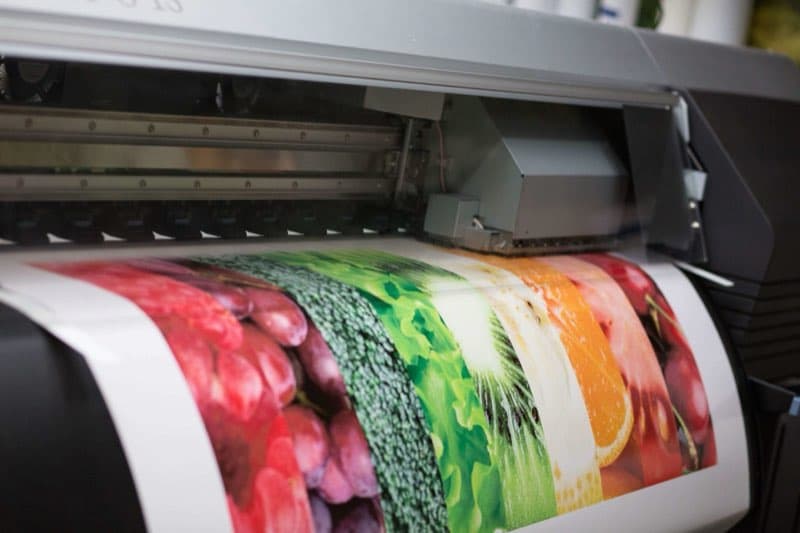
Large format printing (also called wide format printing) uses inkjet technology to print onto a wide range of substrates at sizes that far exceed what a traditional offset press can handle. Key characteristics include:
- Prints widths typically from 24" up to 120" or more.
- Can print on vinyl, fabric, canvas, mesh, foam board, rigid substrates, and more.
- No plates required — files print directly from digital files.
- Economical even for single pieces or very short runs.
- Ideal for banners, posters, trade show displays, window graphics, wall murals, and outdoor signage.
Core Differences Summarized
- Size: Large format printing can produce pieces many feet wide; lithography is generally limited to standard sheet sizes.
- Substrates: Large format prints on rigid and flexible materials; lithography is primarily paper-based.
- Volume: Lithography is best at high volumes (1,000+ pieces); large format is efficient for low quantities and one-offs.
- Use case: Lithography for commercial print collateral; large format for signage, displays, and environmental graphics.
- Plate setup: Lithography requires plates; large format is plate-free.
When to Use Each Method
Choosing between large format printing and lithography comes down to the nature of your project:
- Need a 10-foot banner for a trade show booth? Large format printing.
- Printing 5,000 branded brochures for a product launch? Lithography.
- Creating a storefront window graphic? Large format printing.
- Running 10,000 direct mail pieces? Lithography.
- Producing a single foam-core presentation board? Large format printing.
The Production Workflow Behind Each Process
The two processes feel different to work with because their production paths diverge from the start. A lithographic job moves through prepress and imposition, then to plate-making, then onto the press for makeready and color approval before the run proceeds — a sequence built for repeatability across thousands of identical sheets. A large format job skips plates entirely: the file is preflighted, processed through a RIP that applies the right color profile for the chosen material, and sent straight to a wide-format printer, often as a single piece. This is why lithography rewards lead time and volume, while large format is well suited to fast, one-off, or made-to-order work where each piece may differ in size or substrate. When the calendar is the deciding factor, it's worth checking typical large format printing turnaround times before you settle on a process.
Durability and Finishing Differences
Because the two processes serve different environments, their finishing needs differ too. Lithographic pieces are typically trimmed, folded, and bound — operations designed for paper that will live indoors in a reader's hands. Large format finishing is engineered for display and the elements: laminating for scuff and UV protection, grommeting and hemming for hanging, pole pockets for tension displays, and mounting to rigid board for standing signage. A banner headed outdoors may also need wind-rated material and weatherproof inks, considerations that simply never arise for a paper brochure. Matching the finishing to the application is as important as choosing the printing process itself.
Resolution and Viewing Distance: A Crucial Distinction
One of the most practical differences between the two processes is how much resolution your files actually need. Lithography is built for close inspection — brochures, books, and stationery are read at roughly twelve inches, so images are prepared at 300 PPI and printed with a fine 150 to 200 LPI halftone screen. Large format is engineered around viewing distance. A banner read from ten feet away simply does not need the same pixel density, so files are commonly prepared at 100 to 150 PPI at final size, and a building-scale graphic viewed from across the street can be acceptable at even lower resolution. Understanding this saves enormous file sizes and prevents the common mistake of trying to build a 30-foot banner at print-shop resolution.
Color Handling: Spot Inks vs. Wide-Gamut Inkjet
Lithography can run true Pantone spot inks mixed to exact specification, which makes it the dependable choice when a brand color must reproduce identically across thousands of pieces and across separate print runs. Large format printers, by contrast, build color from wide-gamut inkjet sets — CMYK plus, on many machines, light cyan, light magenta, orange, green, and sometimes white — to approximate Pantone targets closely, typically within a small Delta E. For most signage that approximation is excellent. For brand-critical signage, a printed substrate proof on the actual material is the way to confirm the match before committing to production.
Cost Structure Compared
- Lithography: Higher fixed setup (plates and makeready), very low cost per unit at volume. The economics reward long runs.
- Large format: Essentially no setup cost, with pricing driven by square footage of material, ink coverage, and finishing. A single piece is economical, but there is little volume discount per square foot.
Frequently Asked Questions
Can lithography print a poster? Yes, up to the press sheet size — commonly around 28 by 40 inches. Beyond that, large format is required.
Can large format match my printed brochure colors? Closely, but not always identically, because the ink technologies differ. For tight matching, supply the brand's Pantone references and request a material proof.
Which lasts longer outdoors? Large format on outdoor-rated vinyl or aluminum with UV-stable inks is designed for the elements; standard lithographic paper is not an outdoor material.
Can one project use both processes? Yes, and many do. A campaign might run lithographic brochures for a mailing while producing matching large format banners for the event — same brand, two processes, each chosen for what it does best.
Ultimately, large format and lithography are complementary rather than competing tools. Lithography excels at high-volume, close-read paper products where per-unit cost and exact color consistency matter most, while large format dominates display work at scales and on materials that paper presses cannot touch. Understanding where each shines lets you spend your budget wisely and produce every component of a project — from the mailer to the storefront banner — at the quality its purpose demands. The best results come from asking not "which process is better" but "which process is right for this specific piece," and then letting that answer guide your material, resolution, and finishing choices. Real estate marketing is a classic example, pairing lithographed property brochures with large format signage for the same listing.
VSL Print Handles Both in Manhattan
Located in Midtown Manhattan, VSL Print has been serving NYC businesses with both large format and lithographic printing since 2009. Whether you need a fleet of retail banners or a high-volume direct mail campaign, our team will match your project to the right equipment and give you a competitive quote. Contact us today — we're ready to help.
Looking for professional large format printing?
View Large Format PrintingReady to start your print project?
Get a free quote from a NYC commercial printer. Rush turnaround available.